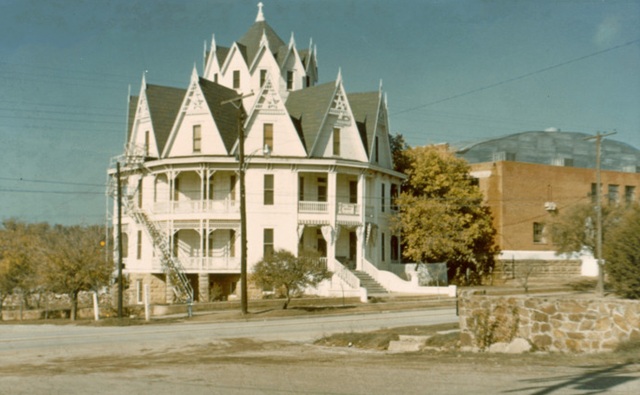
The famous Hexagon Hotel in Mineral Wells, Texas, was designed and built by David G. Galbraith, who originally owned a sprawling 99,000-acre ranch in Garza and Lynn counties before selling his holdings to move into hospitality. Inspired by the geometric perfection of honeycombs, he set out to build a highly unique hotel, known as the Hexagon Hotel, located in Mineral Wells on the 700 block of N. Oak St. Construction started in 1895 and was completed in 1897.
The Hexagon Hotel also had a DC generating plant, which furnished power to an electric light in each room. It was the first electrically-lit hotel in Mineral Wells. The plant was operational when the Hexagon Hotel opened. There was also a steam laundry and an ice house. The ice house produced its first block of ice in 1903. The hexagonal shape was designed to maximize air circulation 61 years before air conditioning became available. Mr. Galbraith was the inventor of one style of the paper clip (not the current well-known version, the GEM Clip). The Convention Hall building at 715 N. Oak St., located next door to the Hexagon House, was built in 1925 on the site of Mineral Well’s first electrical generating plant (DC). The Convention Hall was torn down by the city in 1977.
Construction of the Hexagon Hotel was started in 1895 and completed in 1897. It was constructed of long-leaf yellow pine; the exterior was cypress siding, and the roof was covered with hand-split cypress shingles. The interior was of “Heart of Pine” (The hardest that could be found) wood.
The Hexagon Hotel according to Winnie Beatrice McAnelly Fiedler (A thesis presented…to the University of Texas.. for the Degree of M.A….):
Galbraith purchased Lot No. 19 in the Wiggins Addition for $1,500. It was opened in 1897, and its telephone number was “6.” Galbraith himself died in 1927. All the stone work was done by two English stone-masons. The building was constructed with pegs and square nails. The four staircases inside spiraled through the five floors. The lobby floor was covered with hexagon-shaped tan, brown, and blue tiles. The rooms were hexagon-shaped with a bath between every two rooms. The hotel was torn down for the materials in the building in September 1959. (This information is found on page 106, “Time Was in Mineral Wells” by A.F. Weaver)
Digital Access:
The Boyce Ditto Public Library provided this localized historical collection to The Portal to Texas History, meaning you can view scanned portions, photographs, and editions of the book online for free.
Physical Reference: Because it is the definitive pictorial history of the city’s founding and growth, physical copies and related archive photos are maintained locally by the library’s historical department. If you plan to view a physical copy at the library, we suggest you call to learn their operating hours or contact information to verify if it is currently on the shelf or kept in their restricted local history archives
(940) 328-7880
The hotel was sold, for a brief time, to the Caldwell family, and it was dubbed “The Caldwell-Hexagon Hotel.” It was advertised under that name in the Jacksboro “Gazette” of June 4, 1914, stating that it had its own “Deep well, fresh water.” Rates were given at $12.50 per week.
The “Palo Pinto County Star (Mineral Wells, Tex.)” remarks (in 1966) that “Rates in season were $1.50 per day; out of season, $1.00 per day, which included bath privileges. Meals were available at nearby hotels.” The “Star” goes on to relate that the Hexagon Hotel was converted into apartments at some time prior to its demolition, but it does not say exactly when this conversion was made.
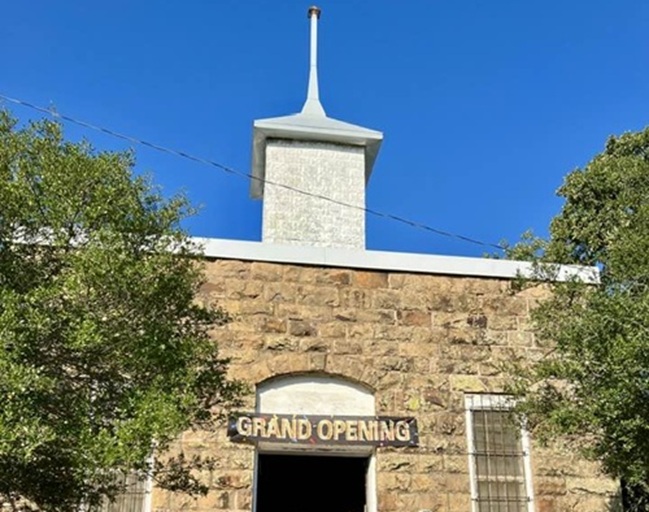
Come to the Mineral Well Heritage Association’s Rock School Museum
and visit the replica of this historic building, built totally from paper products
by former Mineral Wells resident Tom Beauregard.
This paper replica he helped build in 1976. This was a project of the Mineral Wells Art Association made for the 1976 bicentennial parade. The local parade celebrated the nation’s 200th birthday. The project was made in Beauregard’s home on S.E. 11th Street, and he said it took just two months to create.
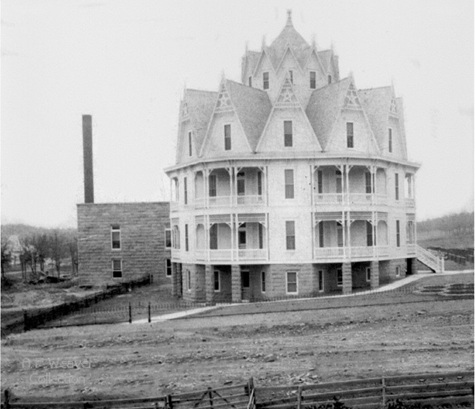
Hexagon Hotel
The earliest photo of the completed Hexagon House
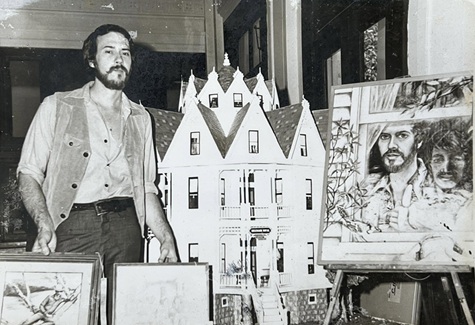
Hexagon Hotel Model Rock School Museum
Hotel Model Artist, Tom Beauregard
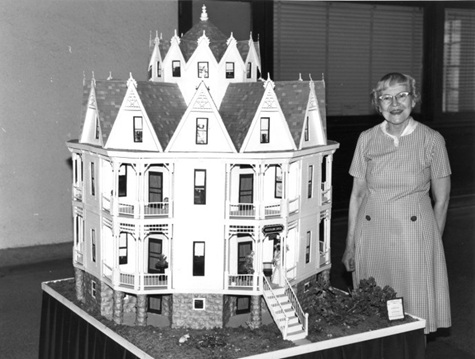
Hexagon Hotel Rock School Museum
Daughter of David Galbraith, Elizabeth Sickels 1977.

This is another wonderful article.
A fascinating and historic building. I was fortunate enough to see it when I was young, but to young to appreciate it for it’s significance. I wish the elders in the community would have shown their appreciation for it.