
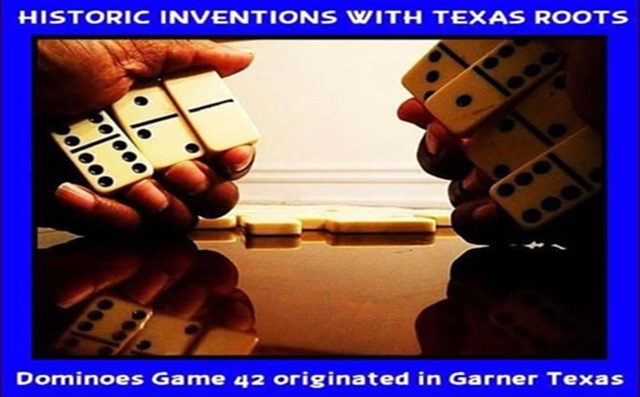
The 42 Domino Game originated in Trappe Springs (now Garner), Texas, around 1887, when two boys, William Thomas and Walter Earl, created a domino game mimicking card games like pitch to bypass religious prohibitions on cards. It became Texas’s official domino game in 2011, spreading via families, soldiers, and domino clubs, evolving into a beloved, strategic trick-taking pastime central to Texas culture, played with a standard double-six set where 42 points are scored per hand.
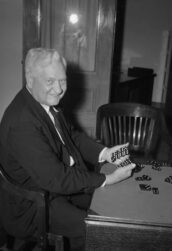
William Thomas, co-inventor of the 42 Domino game
The boys taught the game to their community, and it quickly spread through families and local gatherings in Texas.
The game became a staple at Texas A&M University as early as the 1890s, further embedding it in state culture.
Traveling salesmen and soldiers helped spread 42 beyond Texas, even to the front lines of World War II.
In 2011, the Texas Legislature passed a resolution officially recognizing 42 as the state’s domino game, celebrating its unique Texan heritage.
How it’s Played (Briefly)
Teams: Four players in two teams of two, partners sitting opposite each other.
Objective: Be the first team to score 250 points (seven “marks”) by winning tricks containing scoring dominoes (5s, 10s).
Bidding: Players bid to name the trump suit and style of play, similar to bridge or spades.
Christopher Evans, a writer for the Fort Worth Star-Telegram, authored an article in August 1985 that indicates the 42 Domino originated in Garner, Texas, in 1887. Garner is a small Texas town located less than 10 miles east of Mineral Wells. According to Evans, before its name was changed, Garner was called Trappe Spring.
It was there that two boys, William A. Thomas and Walter Earl, reportedly “invented” the domino game 42.
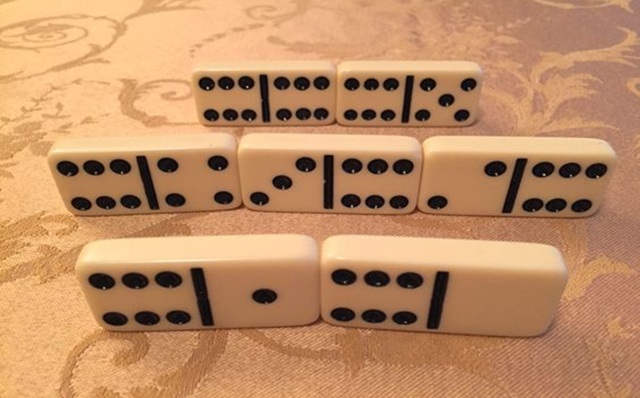
Evans reported that Thomas, 12, and Earl, 14, children of devout Baptists, were caught playing cards in the hayloft of a barn. Playing cards was considered sinful in those days, and the boys were disciplined for their indiscretion.
Well, necessity breeds invention, and, according to Evans, the two boys set out to find a way to play cards using dominoes. By the fall of 1887, they had devised a four-player game using double-six dominoes that incorporated bidding and trumps, very similar to the game of 42 played in Texas today.
Since domino playing was acceptable to their parents and other residents of Trappe Spring (Garner), Thomas and Earl began teaching others how to play the game. The game caught on and spread from there. The Earl and Thomas families later moved to Windom in Fannin County (north-northeast of Dallas), and the game reportedly spread from there, too.
According to Evans, William Thomas told the story about his co-inventing the game in a 1927 interview with the Dallas Journal newspaper. William Thomas died in 1946.
Many other stories are floating around that suggest the 42 Domino Game was started in other towns and locations. The following article seems to give evidence to the information above.
The Garner Story, Reported Origin of 42 Domino Game
Some dismiss 42 as a game of luck. The late bridge expert Oswald Jacoby said it is, and a lot of Texas’ top domino players—Charles B. Wallace, Ralph Foster, and George McAlister among them—agree. Now, it may be true that the mathematical calculations required in 42 are less intricate than those required in regular dominoes. And the rules of 42 may be fairly simple compared with those for bridge. But 42 is no more a game of luck than poker is. Forty-two is a game of bluff, finesse, psychology, and calculated risk. The timid player never wins, nor does the compulsively intrepid one. Forty-two is a fast game with straightforward rules, but it is rough on those who don’t consider their opportunities seriously.
Share anecdotes or your experience with the game in the comments below

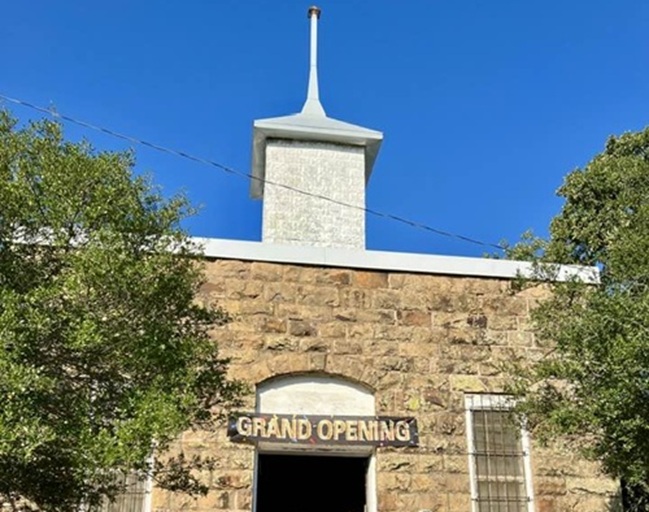
The game of 42 was invented in a barn exactly where our house sits now. Our home is on Old Gerner Rd. about 1.5 miles E of Garner.
Garner’s first school was also on property we now own.
Source of information: Jeramy Lionburger. Jeramy is writing a book about Garner area. Book will be a great history of the area
Fantastic. Do you have material you would like to loan to the Rock School Museum in Mineral Wells, or photos?
We hope Jeramy will share with us any further information.
He may want to post some chapters here to create a larger audience
The Trapp’s Spring Schoolhouse, established in 1876, stood roughly one mile east of present-day Garner. Just a few hundred yards southeast of the schoolhouse, on the W. A. Thomas Sr. farm, the game of 42 was born. During the summer of 1887, the two boys—caught playing cards in a barn located on the very spot where the Hobson home now stands—began working out the rules of what would become Texas’s most famous domino game.
William’s father hauled peaches by wagon from the Trapp’s Spring orchard to Mineral Wells, selling to tourists and townspeople drawn to the growing resort community. William and Walter often traveled along, and wherever the wagon stopped, the boys shared their new game with anyone curious enough to sit down and learn. In this way, 42 spread outward from Parker County, moving steadily across North Texas and into the broader Southwest.
By the turn of the twentieth century, 42 was being played in homes, churches, and social gatherings across Texas. Walter Earle did not live to see the full reach of their invention, passing away in 1904. William Thomas went on to build a successful career in real estate and later served as a regional collector for the Internal Revenue Service, yet he never lost his affection for the game born in a barn near Trapp’s Spring. Its spread accelerated during the two World Wars, when Texas servicemen carried 42 with them and taught it wherever they were stationed. Today, recognized as the official State Domino Game of Texas and played in tournaments across the state, 42 remains a lasting reminder that something enduring can grow from the most ordinary of places.